
If a crop grows well and the fibre looks promising, it is tempting to imagine a building product at the other end. I understand the appeal. Miscanthus, hemp, flax and wetland crops give us a much more interesting set of raw materials than the familiar choice between mineral, fossil and timber inputs. But there is a great deal of work between a field and a product a builder will specify.
That gap is why the Building Based on BioBased project caught my attention. The Interreg North Sea partnership brought together 16 organisations across five countries to develop regional value chains for bio based materials. Its final conference took place on 1 October 2026, with pilots and practical tools on the agenda. The useful point is the breadth of the work: crops, processing, design, production, construction and demand have to meet somewhere. [1][2]
What is the customer actually buying?
A designer or contractor is rarely buying “hemp” or “miscanthus” in the abstract. They are buying a board, an insulation system, a panel or a block that solves a problem on a real job. Will it fit the detail? Can it be cut and installed with the available skills? Is the thermal or acoustic performance measured in the intended assembly? What about moisture, fire, durability and insurance? And if the price is higher, what value compensates for it?
This is where the customer’s question is useful: “What is in it for me?” Lower embodied carbon may matter, but it will not rescue a product that delays a build, fails a specification or creates an awkward warranty conversation. A good crop story should strengthen a good product offer, not stand in for one.
The project’s published pilots span building and road components, a hemp house, interiors and other demonstration settings. Its outputs also include a method for mapping bio based value chains and a survey of initiatives involving flax, hemp, miscanthus and cattail. These are project activities and tools, not evidence that every proposed material is already certified or commercially competitive. [3][4]
A real example closer to home
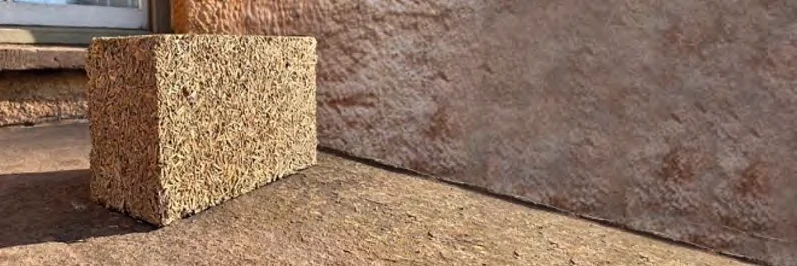
Miscrete gives us a real example. Tŷ-Mawr’s January 2025 Tŷbloc information sheet describes a non-load-bearing insulating block made with British-grown Miscrete miscanthus fibre and a lime-based binder. It identifies possible uses including wall insulation, partitions and timber or steel frame infill. There is a defined product here, rather than just an interesting crop. [6]
But the buyer still needs current evidence for the intended installation. The sheet marks its listed test figures as preliminary or indicative, and leaves vapour permeability and reaction to fire to be confirmed. What do today’s test reports show, and how does the block perform in the complete wall? Cost, availability and ease of installation matter too. The useful story is the progress from crop to product—and the measurements still needed before a specifier can rely on it. [6]
The missing steps are often quite ordinary
First, supply. A manufacturer needs to know who grows the crop, how much can be delivered, at what moisture and specification, in which months, and at what price after transport and storage. “Locally grown” is attractive; a missed production run is not. An agreed specification and a realistic offtake arrangement matter as much as hectares on a map.
Next, processing. Fibre length, particle size, ash, binders and water all affect the product and the factory. The BBoBB pilot looking at concrete and asphalt, for example, is investigating lignin and used vegetable oils as possible bio based components. The project describes what it is considering and hopes to demonstrate; it does not publish measured field performance on that pilot page. [5] That distinction is worth keeping. A promising formulation is a reason to test, not a reason to print a claim on a brochure.
Then comes the site. A product that works in a laboratory needs to survive ordinary handling, imperfect weather, trades working in sequence and a purchaser who has a budget and a deadline. The installer is part of the customer chain. If the new material needs unfamiliar equipment or a longer programme, those costs belong in the proposition.
Start with one application and prove it properly
I would begin with a specific use case rather than a list of possible markets. Take a non structural interior panel, for example. Agree the dimensions, surface finish, acoustic or thermal target, fire and moisture requirements, installation method and expected service life with a prospective buyer. Then make a small batch, test it independently where appropriate and put it into a controlled pilot. Record the batch variation and the installation time as carefully as the best laboratory result.
If the result is disappointing, the learning still has value. Perhaps the fibre is better suited to a different density, a different binder or a different customer. Perhaps a hybrid system makes more sense than an entirely plant based one. We should be willing to change the product brief when the evidence asks us to.
The end of life needs the same honesty. Can the finished product be separated during refurbishment or demolition? Do binders and treatments allow the proposed recycling route? If a claim depends on a collection system that does not exist locally, it is a future possibility, not a current benefit. The same care applies to carbon claims: provenance, processing energy, additives, use life and the comparison product all affect the answer.
A useful next question
The BBoBB work is a reminder that the bioeconomy is built by connecting people and processes, not simply by discovering another promising plant. For miscanthus and other fibres, I think the best next question is a modest one: which single building application has a buyer willing to define the requirement and help test a real prototype? Get that answer, and the field starts to look less like a story and more like the beginning of a supply chain.
Source facts and AgriKinetics commentary
Source facts: [1] the project partnership has 16 partners in five North Sea countries; [2] the final conference was held on 1 October 2026 and presented pilots and project tools; [3] the project lists several construction and interior pilots; [4] its outputs include value chain methods and an initiatives review covering flax, hemp, miscanthus and cattail; [5] one pilot is investigating lignin and used vegetable oils in concrete and asphalt. [6] the January 2025 Tŷbloc sheet describes the fibre and lime binder, intended non-load-bearing applications and preliminary test status. Facts [1]–[5] come from the project’s own pages; [6] comes from Tŷ-Mawr’s supplied information sheet.
AgriKinetics commentary: the buyer questions, proposed staged test, likely implementation friction and suggested pilot sequence and questions for Miscrete specifiers are editorial analysis. The article does not claim that BBoBB has proved commercial viability, quantified carbon savings or certified particular products.
Direct sources
- Interreg North Sea, Building Based on BioBased project overview. Read the primary source.
- Interreg North Sea, Final Conference Building Based on BioBased, 1 October 2026. Read the primary source.
- Interreg North Sea, BBoBB pilots. Read the primary source.
- Interreg North Sea, BBoBB outputs. Read the primary source.
- Interreg North Sea, Bio based components for insulation in buildings and road pilot. Read the primary source.
- Tŷ-Mawr Lime, Tŷbloc® information sheet, Version 1 (January 2025), pp. 1–2. Supplied by David Stone; this is the version used for the fibre, binder, intended-use and preliminary-test statements. Visit the manufacturer’s product page for contact and current product information; that page is distinct from the supplied sheet.
Sources checked on 12 October 2026. The January 2025 Tŷbloc sheet is product background, rather than a new announcement or evidence of today’s test status.