
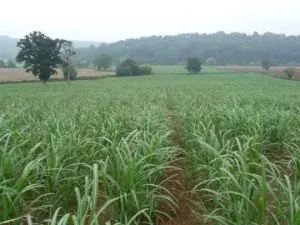
Giant Miscanthus Giganteus is the ideal crop for the emerging Cradle to Cradle economy, with a wide range of uses in biocomposites, land remediation and renewable energy.
Background
The phrase Cradle-to-Cradle was invented in 1970 by Swiss Walter R. Stahel, who heads the Product-Life Institute. This concept was also elaborated by German chemist Michael Braungart and American architect William McDonough, in their book 'Cradle to Cradle: Remaking the Way We Make Things'.
The Idea Behind Cradle-to-Cradle
In nature, there is no waste. The waste produced by one organism is food or raw material for another. All material on earth is cycled and recycled in a closed loop.
Cradle-to-Cradle advocates production design based on this principle of nature. It is a business model based on intelligent design, that is eco-effective and waste-free, since all components are recycled as 'biological' or 'technical' nutrients.
How the Model Works
The Cradle-to-cradle production process ensures that the products are designed for disassembly, so that the component parts can be separated and used again to make the same product or a product of higher value.
This model recognizes two types of materials flow:
- Biological nutrients: Natural materials that can be composted and returned to the environment
- Technical nutrients: Mineral resources or synthetics that move in a closed loop of production, recovery and remanufacturing
Circular Economy
Circular economy can be ecological, by reducing the amount of raw materials that are used in the production process, and thereby eliminating waste. It can be socially beneficial when the production process reduces use of energy and uses manpower, generating jobs and reducing poverty.
AgriKinetics' Commitment
Miscanthus × giganteus is a productive C4 perennial crop with the potential to support lower-input land use and soil-carbon accumulation. Its overall greenhouse-gas and water-quality effects are site- and management-dependent and should be assessed across the complete value chain.
Miscanthus even recycles nutrients, by translocating nutrients to its underground tissue during autumn, to be used by the crop that sprouts next year from its rhizomes, in classical Cradle-to-Cradle fashion!