
Growing sustainable Miscanthus Giganteus is a positive route to incorporation of sustainability and organic practices into a profitable farming roadmap.
Sustainable Agriculture
Sustainable agriculture is defined 'as practices that meet current and future societal needs for food, fibre, energy, ecosystem services, and healthy lives'. So in the calculation of net benefit to society, all costs and benefits of agricultural practices must be considered.
Environmental Costs of Conventional Agriculture
Conventional agricultural production and distribution are directly responsible for 14 per cent of total greenhouse gas emissions. This is mainly due to use of chemical fertilization and use of fossil fuels for tillage. Chemical fertilizer production is energy-intensive and releases greenhouse gases.
What Makes Miscanthus Giganteus Sustainable?
Sustainability of energy crops is determined by input levels, recycling of nutrients, application of pesticides, water use efficiency, pollution and soil carbon-sequestration. Miscanthus Giganteus is one of the most popular lignocellulose energy crops, and it is sustainable due to its functional traits.
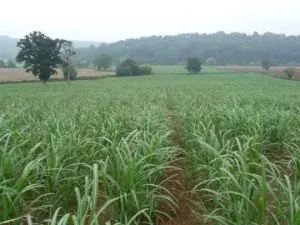
Giant Miscanthus is a perennial tall grass with a C4 photosynthetic pathway. C4 plants have nearly twice the water-use efficiency (WUE) of C3 plants and a higher potential biomass yield. It grows up to 4 metres high and roots go down 2.4 metres deep.
Inputs and Nutrient Recycling
Similar to switchgrass, Miscanthus Giganteus translocates most of the nitrogen, phosphorus, potassium and other minerals in the shoots down to the rhizome and root system, by late Autumn. So, even though the above ground biomass is harvested, the nutrients remain underground.
In a study by the University of Illinois, Giant Miscanthus was found to reduce nitrogen pollution in water more than switchgrass, corn or soybeans.
Pests and Diseases
In Europe, Miscanthus Giganteus is relatively free of insect pests and diseases when compared to N. America, reducing dependence on chemical pesticides.
Water Use Efficiency
Miscanthus Giganteus has a higher WUE than oil, or sugar and starch crops. Moreover, its effect on the quality of water is beneficial, as it reduces the nitrate concentrations in it, to below drinking water quality.
Soil Carbon-Sequestration
The greenhouse gas (GHG) balance of production and utilisation of energy crops is approximately zero, as the crop burnt releases carbon dioxide that it had captured during its vegetative stage. Since perennial crops do not need repeated tillage, 37% of GHG emissions are reduced.
Short rotation coppice (SRC) crops lasting for 1-25 years, such as Miscanthus, effect considerable soil carbon-sequestration to the tune of 160 – 640 kg C/acre/year, saving 0.6 – 2.4 t CO2/acre/year.