
Use of Miscanthus Giganteus and other biomass is considered by the EU and UK as a significant factor to meet its 2020 and 2050 targets in reducing greenhouse gas (GHG) emissions. The Climate Change Act 2008 of UK aims for reduction of domestic greenhouse gas emissions of 34% by 2020 and of at least 80% by 2050.
Present Scenario in UK
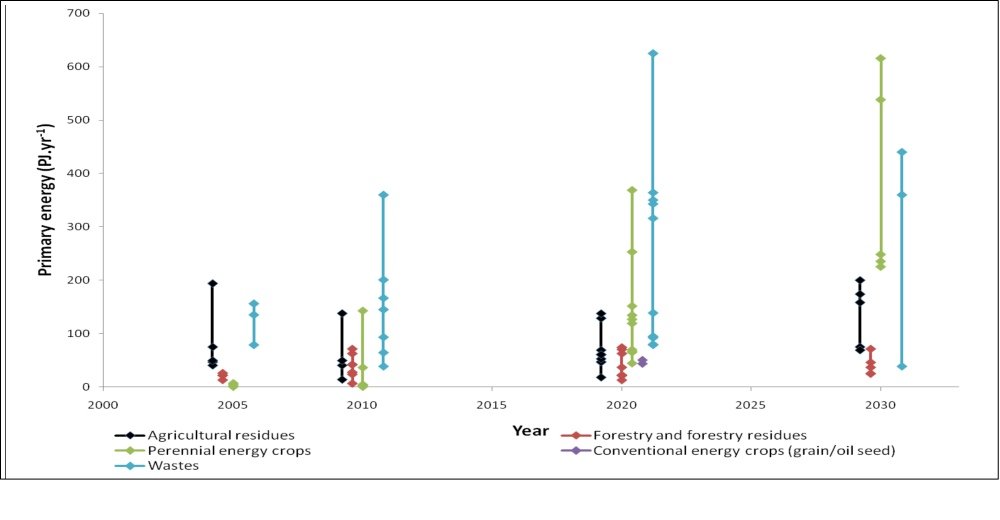
In 2024, bioenergy crops in the UK covered 142,000 hectares, representing 2.3% of arable land. Miscanthus giganteus accounted for approximately 7,400 ha in England, with short rotation crops (SRC) like willow at 5,200 ha. The UK government's sixth carbon budget targets 30,000 hectares of perennial energy crops annually by 2035, with an ambitious goal of 700,000 hectares by 2050 to meet net-zero targets.
Why Miscanthus is the Best Choice
1. More Sustainable
The perennial grasses, specifically Miscanthus Giganteus and SRC are seen as being more sustainable since they have a lower carbon impact (0.5 to 6.1 t CO2 e/ha/yr), than the annual food crops (3.4 to 11t CO2 e/ha/yr).
2. Profitability
Miscanthus can be planted on 0.72 – 2.80 Mha at a profit margin of £526/ha to generate 59.3 Twh.
3. Yield
In UK, Miscanthus Giganteus yields average 12-15 oven dried tonnes per hectare. In Illinois, US, Miscanthus produces 2½ times the amount of ethanol produced per acre of corn or switchgrass.
4. Land Quality
Miscanthus and SRC are suitable for growth on land of low productivity, or those contaminated with heavy metals, even though yield may be less than optimal.
5. Environmental Impact
Giant Miscanthus and SRC have less environment impact on soil, air and biodiversity. They support more flora (weeds), birds, invertebrates, as well as soil microflora and microfauna compared to cereal crop fields.
6. Chemistry
Since Miscanthus Giganteus has lower concentrations of moisture and ash in comparison to other bioenergy crops, it is being considered as a key candidate for use in biomass-to-liquid fuel conversion.
Conclusion
Considering yield, profitability and chemistry, Miscanthus Giganteus proves to be the better option even among perennials and SRC. The government wants to increase area under Miscanthus by 20% every year, to cover 0.04 Mha by 2020.