
'Why use up forests which were centuries in the making and the mines which required ages to lay down, if we can get the equivalent of forests and mineral products in the annual growth of the fields?' - Henry Ford
Background
Manufacturing in Europe has declined steadily for decades, due to the financial crisis, competition from developing countries, and a shift toward service-based industry. Manufacturing traditionally creates jobs across sectors and drives research/development.
EU Policy
The EU Green Deal Industrial Plan (2023) and Clean Industrial Deal (2025) now drive Europe's clean manufacturing agenda. The Net-Zero Industry Act targets 40% of net-zero technologies to be manufactured domestically by 2030, with key priorities including:
- Sustainable biogas and biomethane production
- Bio-based products and materials
- Advanced clean technologies
- Critical raw materials security
- Carbon capture and storage
- Renewable energy systems
- Grid technologies and energy storage
The EU's renewable energy target is 42.5% by 2030. Biomass remains the largest renewable energy source, representing 46% of all EU renewable consumption in 2024. Transitioning to a bio-based economy requires substituting petrochemical and mineral materials with renewable plant resources like Miscanthus.
Land Availability
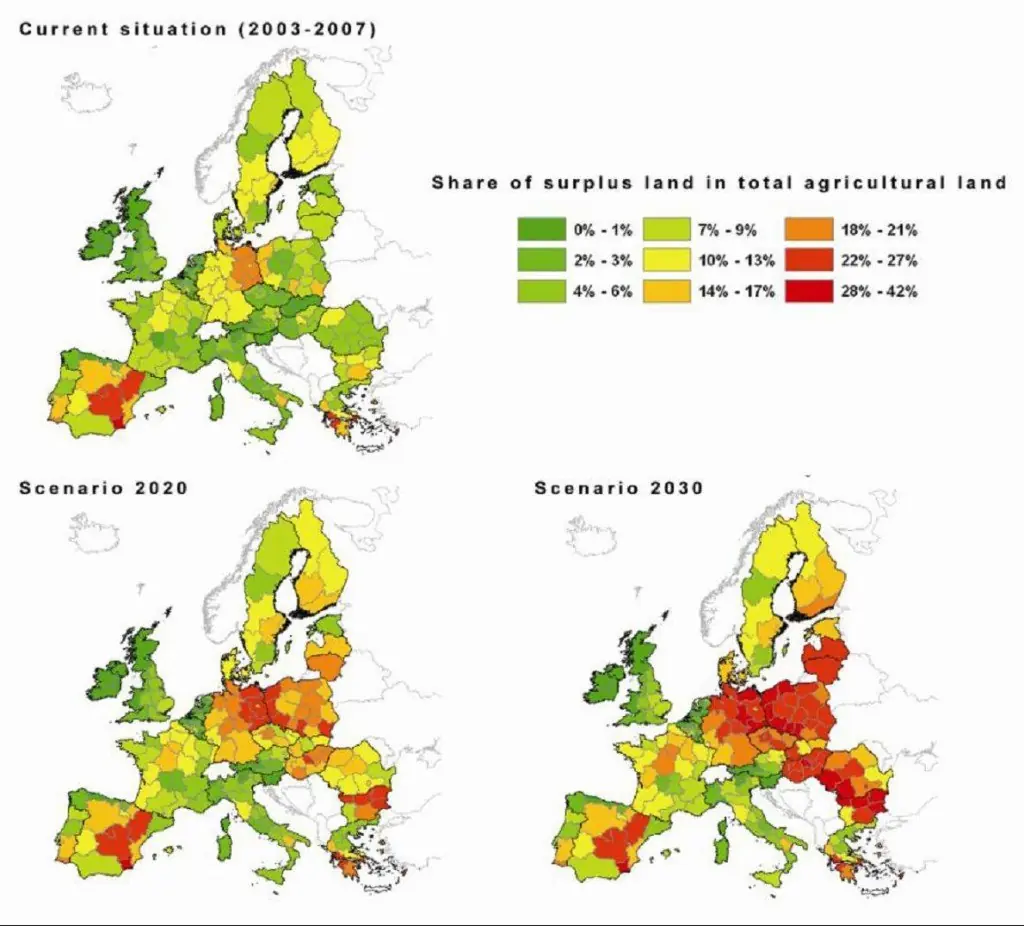
Surplus agricultural land expected to reach 14-21% of EU total in 2020 (22-42% by 2030). Non-food crop land could expand to 20.5Mha (2020) and 26.5Mha (2030).
Bio-Based Economy: New Materials
Adopting "cradle to cradle" manufacturing promotes sustainable raw material demand across construction, composites, textiles, and pharmaceuticals.
Natural fibers offer advantages over synthetic alternatives:
- Lower cost and density
- Competitive mechanical properties
- CO₂ sequestration
- Sustainability/recyclability
- Biodegradability
- Biological processing capabilities
Miscanthus x Giganteus Key Attributes
- Potential for comparatively low lifecycle greenhouse-gas emissions when appropriately grown and used
- Minimal chemical inputs
- High annual biomass yield
- Cellulose output three times higher than trees
Applications
Composites manufacturing (particle/MDF boards for construction/furniture), biocomposites used in musical instruments, surfboards, packaging, horticultural products, and automotive components (door panels, seat backs).