
How Miscanthus giganteus, and its many uses and products in Europe, relate to Agenda 21. Since Agenda 21 is a massive document, only sections of it relevant to our theme have been considered here.
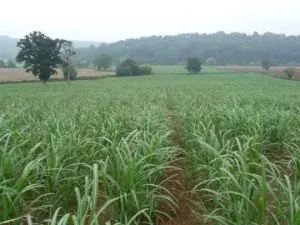
The cultivation of Miscanthus giganteus fits with many of the prominent recommendations made by Agenda 21. These address some of the main concerns covered in Agenda 21 regarding agriculture, energy production and its use, and business ethics.
Agriculture
Miscanthus giganteus is being promoted as an important non-food crop suitable for Europe. One of the factors making it attractive are its high yields, an average 15 tonnes per hectare/year.
As Miscanthus is a perennial crop, a single ploughing operation to plant it can provide yields up to 20-25 years. So the greenhouse gas emissions due to use of fossil fuels is minimal.
Since Miscanthus requires little or no additional fertilisation, and no pest control, further greenhouse gas emission cuts are achieved.
Phytoremediation
Various national actions have identified 2.5 million potentially contaminated sites across Europe. Miscanthus giganteus is being promoted as one of the crops best suited for phytoremediation. It can be grown in sites of varying sizes, is decentralised and suitable as a small to medium sized industry venture.
Energy Production and Use
Agenda 21 wanted a transition to diversified energy sources that integrated alternative new and renewable sources of energy. Miscanthus giganteus is a key bio-energy crop whose carbon balance can be positive if cultivated organically.
Biocomposites Production
Agenda 21 urges the promotion of cleaner production and use of environmentally sound technologies. Bio-composites can be used in the construction industry to cut its carbon footprint by 50%.
Sustainability at AgriKinetics
In agreement with Agenda 21 principles, AgriKinetics is voluntarily engaged in promoting organic cultivation of Miscanthus, and development of sustainable products. It collaborates with like-minded entrepreneurs and farmers across Europe.